
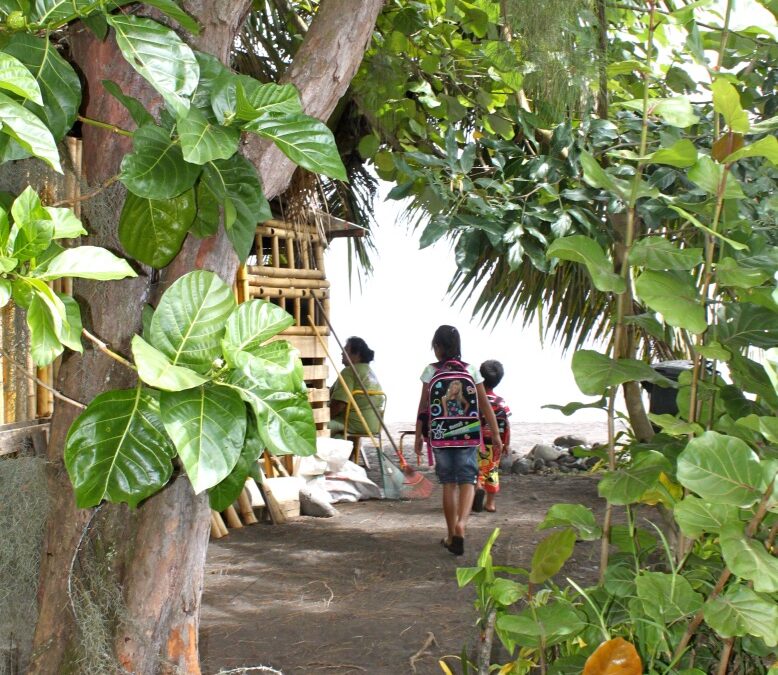
Last fall, some high school students and I had the good fortune to travel to California’s Central Valley for some ranch life. Learning that a nearby farm was practicing regenerative agriculture, we planned a side trip there. The kids were curious to know what regenerative agriculture was.
The concept of regeneration is gaining traction and, I believe, will become part of one of the most fundamental shifts in worldview imaginable for the coming generation. “What is it? It’s your future,” I remember saying as we drove over to see the farm.
The regeneration paradigm isn’t just relevant to farms. It’s critical for learning communities as well, and it’s beginning to inform our vision as educational leaders and friends.
A few months ago, a publisher kindly connected me with the wonderful author and leader Ida Rose Florez, PhD. Ida had just written The End of Education as We Know It, in which she explores what it would take to create more regenerative schools.
So, what would a regenerative school be like? These are learning environments that restore and renew their own conditions for growth, learning, and human flourishing. Ida borrows a striking analogy from the world of regenerative agriculture, quoting Amelie des Plantes from Soil Science for Regenerative Agriculture:
“Segregating our knowledge about soil into Soil Biology, Soil Biophysics, Agronomy, and Soil Chemistry has hindered our view of the big picture of what soil is.”
If you’ve spent any time in a school — especially in a leadership role — you’ll recognize how this same fragmentation plays out in many organizations. Like soil science split into supposedly unrelated disciplines, many of our schools are carved into compartments: curriculum, discipline, mental health, instruction, DEI, assessment, transportation — each managed in isolation, each with its own vocabulary, benchmarks, and gatekeepers. I confess I’ve never done well with this.
The financial bookkeeper doesn’t know the bus driver, who doesn’t know the head of school. Or they know and treat them as a strict function of their job description. We have a simple name for this: bureaucracy. That’s not how connected communities, like great small schools, work when they are working as designed.
But it goes deeper. We divide students by age, by perceived ability, by bell schedules and subject blocks — structural choices that make holistic, cross-disciplinary and real expeditionary learning the exception rather than the rule. Plus, the history teacher simply has to collaborate with the English teacher!
What’s more — less so at Grauer, but almost universally in schools — we divide up all the people who work there. These divisions create artificial boundaries that prevent students, teachers, and stakeholders from exploring the interconnected nature of knowledge and from forming a truly connected community. As Ida notes, “Human development simply does not work that way.” It can be heartbreaking when you learn your “friends” are really just playing a role.
But what if a school were more like soil in a natural ecosystem? What if we applied the concept of reciprocity? I’ve explored this in past columns about the Native American concept of the “Giving Economy.”
Here’s the truth: no learning ecosystem — and no ecosystem — can be properly understood, nor will it be regenerative, without the full, dynamic interplay of forces. Like soil, a healthy school — especially a small one — isn’t a collection of parts, but a living system where the whole is more than the sum of its parts. Families are like this, too, as are many great organizations, clubs, and communities.
In the regenerative model of school, you stop asking mainly, What content are we delivering? Or What is my job? and start asking, a lot more: What relationships are growing here, and what kind of nourishment do they need?
Examples of Regenerative Schools in Practice
As Dr. Florez wrote to me: “I wholeheartedly believe the changes we need will take root at the small and local level.” This is why, once you are familiar with the concept, it’s actually easy to identify elements of regenerative education at schools like The Grauer School, though we’re all works in progress.
I’ve noticed that some schools’ attempts to “treat” anxiety are largely therapeutic or administrative: “let’s create a task force or a program!” But when we asked students to co-design their schedules, find ways to mix into more diverse groups, and identify where in the day they felt agency and connection, everything began to change. Anxiety didn’t completely disappear, but something else grew stronger: ownership. Purpose. Calm. Connection with groups or individuals they might normally avoid or treat superficially.
Why Regenerative Education Matters for Students & Teachers
“Stripping humans of our capacity to see wholes and think in complexity has led to disastrous consequences,” says Ida. Regenerative schooling means we stop fragmenting our understanding of what it means to teach, lead, gather, friend, and learn. It means resisting the push toward over-specialization, accountability without soul (the almost ubiquitous focus on scores and ranks in areas far removed from a school’s true purpose), and metrics divorced from our stated values.
Regenerative schooling means seeing our classrooms, students, alumni, neighbors, grandparents, jobs, and missions like the forest floor — teeming with unseen networks of relationships, growth, decay, and renewal. Work-life separation: Sorry, that’s not for leaders! Our life’s work part of our essence. Work-play separation. Nope! And one thing I know for sure is that, when your 11,000 feet up scrambling up to the top, you are every bit a teacher, student, and naturalist… all in one.
Regeneration happens from within — It’s “learning by mutual discovery.” Like any real, intentional, long-range change, it can’t be imposed from above by bosses, governments, or accreditors. The conditions for it are created and allowed by leaders, if people are willing.
This summer let’s slow down enough to notice the richness of what’s already growing beneath our feet, and in the space between us. All parts of our lives are integrated. Maybe we can regenerate.
How could your school or classroom become more regenerative this summer? If you find these ideas inspiring, share this with other educators or school leaders!
Join the Small Schools Movement!
Would you like your organization or small learning community showcased in our member spotlight? If you are not yet a member of the Small Schools Coalition, we welcome you to become a friend free of charge.
If you are already a member, contact us to discuss how we can give you the complimentary platform to show the entire world what makes your small school special!
Recent Comments