
A new amendment proposes the sale of up to 258 million acres of federally managed public lands across the American West. These lands — overseen by the Bureau of Land Management and U.S. Forest Service — include forests, deserts, and wilderness areas that serve not only as ecological treasures, but as living classrooms.
What happens to education when the commons are sold?
The Creation of Grand Staircase–Escalante National Monument
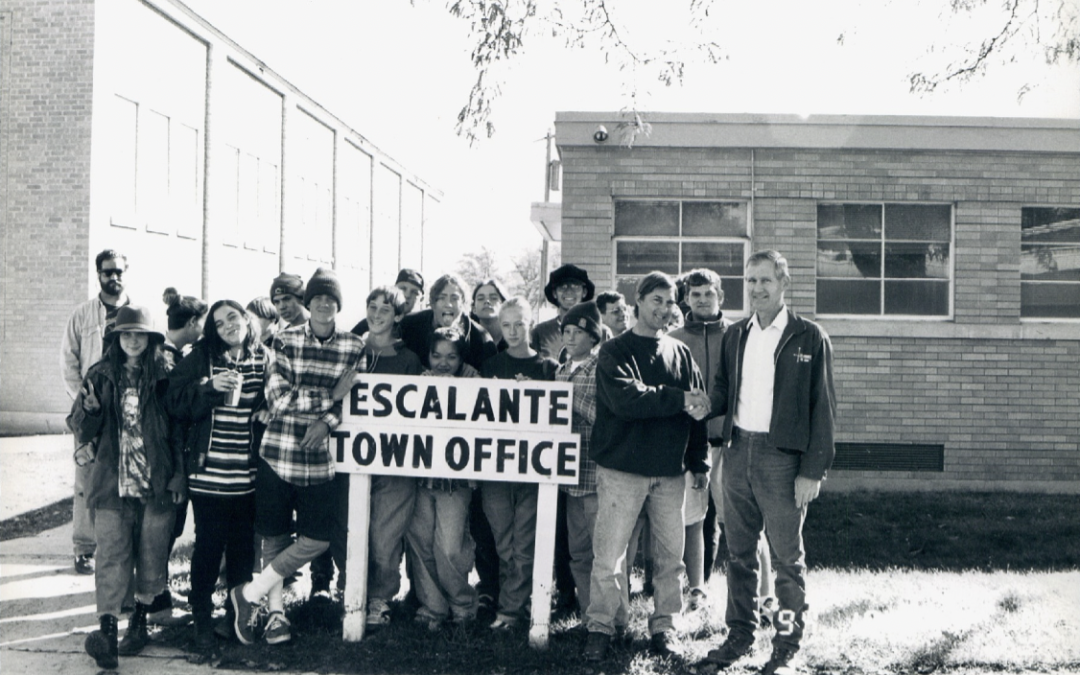
Long ago, in September of 1996, we first travelled to the amazing, dramatic Escalante on a Grauer School expedition. That very week, on September 18, 1996, President Bill Clinton stood nearby at the edge of the Grand Canyon and, under the Antiquities Act of 1906, announced the creation of the Grand Staircase–Escalante National Monument. 1.7 to 1.9 million acres of Bureau of Land Management land, long used for grazing, mining, and logging, were now set aside for permanent protection.
Some celebrated, some cursed. Local communities, including the town of Escalante, had little advance notice. Federal land-use decisions can reshape entire regions quickly and decisively — we need to watch!
In the thick of it, there we were on expedition, studying the grandeur of the Escalante, slipping through the magnificent slot canyons, interpreting the Indian petroglyphs. What did we do? We went to the hearing right there in town in Escalante and sat in on the debate between ranchers and conservationists — a perfect expeditions activity.
At that hearing, we heard how, to the discouragement of ranchers and others, decades of grazing, mining, and logging had already taken a toll on a fragile and incredibly beautiful desert ecosystem. Overgrazing eroded soils and degraded streams, coal and mineral extraction had scarred the landscape and threatened water quality. Logging fragmented wildlife habitat, and cultural sites were sometimes looted or damaged during resource development. We left that town meeting beaming: we felt right in the heart of the action. Result? Today, the amazing Escalante has stayed pristine due to the decision that we observed that very week.
Now imagine this: Imagine if instead of being protected, all that land was simply put up for sale so the US government could cash in, and private developers could take it all over. Imagine the general public lost use of the Grand Staircase and the Escalante?
What the Proposed Public Land Sales Would Do
I hope your imagination is good, because, this week, 258 million acres of federally managed public lands across the American West — including Bureau of Land Management (BLM) and U.S. Forest Service lands, high deserts, alpine meadows, red rock canyons, and backcountry wilderness — stretching across the American West from the Rockies to the Sierra Nevada, from Alaska’s tundra to Utah’s sandstone arches — has been set to be put up for sale with no education, no public hearing, no debate, no national conversation. That’s what’s quietly taking shape under an amendment authored by Senators Mike Lee and Steve Daines. As outdoor journalist Wes Siler reported in Outside, the amendment could authorize the sale of millions of acres of public lands across 11 Western states, including some here in California, on top of an already mandated 3.3 million-acre sell-off in the latest Congressional budget bill. That’s nearly a third of the public lands managed by the Bureau of Land Management and U.S. Forest Service.
Why Public Lands Matter for Education
So, this week’s question: What happens to education when our commons are stripped away? At our school, we’ve always believed that the natural world is not just a setting for learning — it is the teacher. Our students don’t just study ecosystems, they build their sense of belonging by sitting in the waves, or among the coastal sage. We actually placed one-third of our own land into permanent federal and state wildlife conservation easements so it would be forever protected. Every Grauer student hikes those trails in the coastal sage and maritime chapparal.
Great teaching means students don’t just memorize data on climate or geology, they hike it, touch it, climb it. And they don’t just learn civic responsibility from textbooks — they learn it by experiencing what’s at stake.
Press enter or click to view image in full size

Outdoor Education as Civic Responsibility
The erosion or taking of public land protections is not just an environmental crisis. It’s an educational one. If we lose the commons, we lose the ultimate classroom. The research is pounding in that our kids don’t need more technology: their physical and mental health depends upon being in the “real world.”
Wes Siler rightly points out the alarming speed and secrecy of these land sale measures — no public input, no hearings. Meanwhile, foreign billionaire land buyers are mostly anonymously pouring money into political campaigns. Land once held in trust for future generations could soon become private holdings for luxury resorts, cryptocurrency data centers, or offshore wealth havens. Not sanctuaries for deer, rivers, and school groups and wanderers.
What values are being taught here? What kind of future is being shaped when land is seen not as legacy but as political? — not even educational?
At our small school, through years of expeditionary learning, we have tried hard to teach that land is not just something you own. It’s something you steward. The idea that our kids could grow up without access to the very forests and open spaces that have inspired us sets off alarms — not just among educators and conservationists, but on behalf of our children’s children. Kids today overwhelmingly want to be in natural spaces.
If We Lose the Commons, We Lose the Classroom
Great resources are being taken without public process. Education has to step in, right away. Our classrooms are the space where we equip students to understand and defend their own futures, right? We need a generation of young people who know the land, walk it, name it, and love it enough to stand up for it.
In my next lifetime, I sometimes dream, education would not be political. But then, I’d be living in a dream. Now is the time for schools to recommit to outdoor learning, environmental ethics, and civic action — and also to the futures of the children they are educating. The commons and the wilds are only common and wild if someone is willing to protect them. It’s a good time to teach our children well.
In my next lifetime, I sometimes dream, education would not be political. But then, I’d be living in a dream. Now is the time for schools to recommit to outdoor learning, environmental ethics, and civic action — and also to the futures of the children they are educating. The commons and the wilds are only common and wild if someone is willing to protect them. It’s a good time to teach our children well.
Join the Small Schools Movement!
Would you like your organization or small learning community showcased in our member spotlight? If you are not yet a member of the Small Schools Coalition, we welcome you to become a friend free of charge.
If you are already a member, contact us to discuss how we can give you the complimentary platform to show the entire world what makes your small school special!
Recent Comments